Montana Tech, Solvus and UC-Irvine Partner to Develop Sustainable Cement Solutions
Montana Technological University has been awarded more than $1 million as part of a multi-institutional effort to revolutionize how cement is produced and used. The project—Alternative Cement Solutions for Infrastructure Maintenance, Repair, and Construction (ACERS)—aims to reduce the environmental impact of one of the world’s most widely used materials by developing and scaling up cement alternatives.
Funded by the U.S. Army Corps of Engineers (USACE), the ACERS project brings together Montana Tech, the University of California-Irvine and Solvus Global, with each partner tackling a specific task. Materials scientists at UC-Irvine are developing electrochemical methods for cement production in the lab, while Solvus Global, a technology manufacturer based in Leominster, Massachusetts, will scale those methods for real-world applications.
“This collaboration works because each partner brings unique strengths,” said Brandon Weyant, senior automation engineer and program lead at Solvus Global. “Montana Tech understands the local materials and resources, UC Irvine brings deep expertise in cement chemistry, and Solvus focuses on taking research and scaling it into viable, real-world products.”
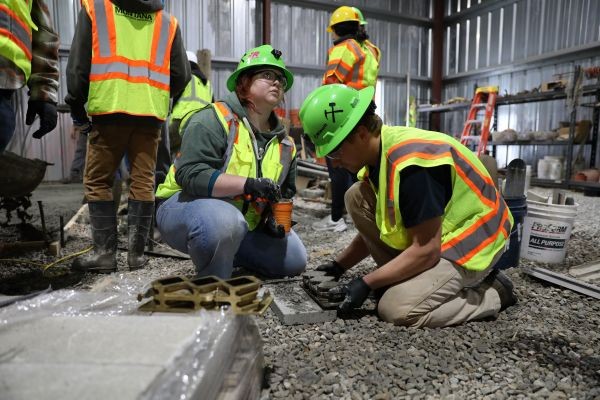
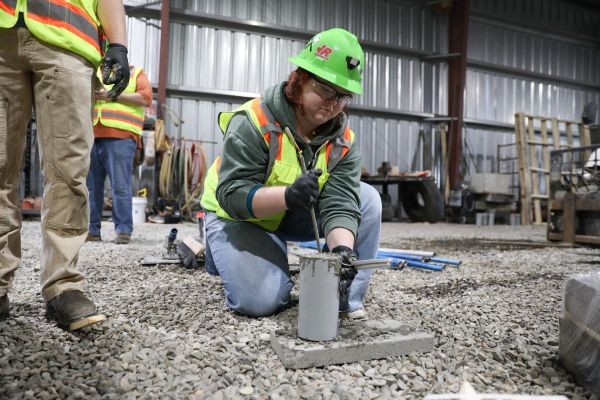
Montana Tech’s focus is to explore how waste materials—such as smelter slag, fly ash, lime waste, glass, cardboard, sawdust, biochar, gypsum, refinery byproducts, wastewater sludge, and certain plastics—can be incorporated into concrete without compromising structural performance. The use of these geography-specific waste products could not only keep valuable resources out of landfills but also reduce the demand for traditional cement, which is the third-largest source of greenhouse gas emissions globally.
Dr. Robin Bullock, director of Montana Tech’s Center for Environmental Remediation and Assessment, is the principal investigator for Montana Tech’s portion of the project.
“Our goal is to find viable cement alternatives using the waste we already produce,” Bullock explained. “Then we can test those formulations in real-world construction settings.”
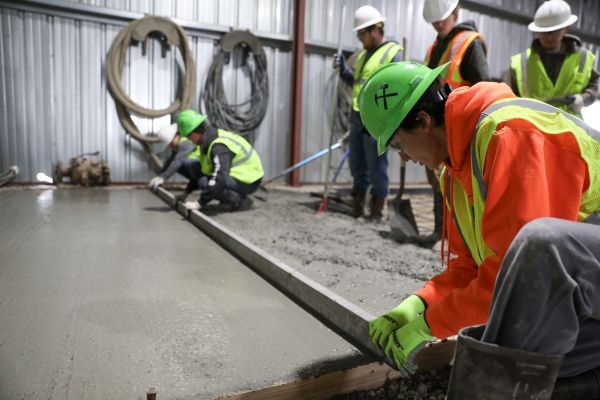
A key part of Montana Tech's role is to pioneer research into 3D printing applications that utilize locally sourced materials from the Montana region as feedstock. To support this initiative, the university plans to acquire a large-scale 3D concrete printer by spring 2026. This new equipment will be central to developing and testing novel, sustainable cementitious mixes derived from regional resources. As a direct result of this primary research, students and faculty across disciplines—from construction management and mining engineering to Highlands College’s construction technology program—will gain invaluable hands-on learning experiences.
Bullock noted the 3D-printed concrete could be especially useful in post-disaster housing and wildfire-prone regions due to its high structural integrity and fire resistance.
“Concrete structures can be put up in days, and they’re much more resilient than traditional wood-framed buildings,” she said.
The project represents a meaningful collaboration forged through longtime academic ties: Dr. Diran Apelian, a distinguished professor at UC-Irvine and a central figure in the ACERS effort, mentored Montana Tech’s Dr. Pat Munday while they were both at Drexel University nearly 50 years ago. Their continued relationship helped bring Montana Tech into the ACERS partnership on the project.
The research is being performed in collaboration with the Concrete and Materials Branch of the Geotechnical and Structures Laboratory at the Engineer Research and Development Center (ERDC) at USACE under Other Transaction for Prototype Agreement number W912HZ259C006. The ERDC strives to be the preeminent materials science research group for military and civil works construction for the Armed Forces. With a long history of developing high-performance materials for applications in the military and national infrastructure, the Concrete and Materials Branch hopes this collaborative effort will result in more robust and resilient supply chains for our Army’s construction needs around the globe.
The views and conclusions contained herein are those of the authors and should not be interpreted as necessarily representing the official policies or endorsements, either expressed or implied, of the U.S. Government. The U.S. Government is authorized to reproduce and distribute reprints for Governmental purposes notwithstanding any copyright notation thereon.